Three layers, three levers
- Large language models — the reasoning layer. LLMs are trained on vast text corpora and generate answers by predicting language. They do not 'know' facts in a database sense; they reproduce patterns. Content that appears consistently, unambiguously, and in machine-parsable form across the training corpus becomes the pattern the model reproduces. Content locked in images, behind logins, or phrased in ambiguous promotional language does not.
- Semantic search — the meaning layer. Modern retrieval converts queries and documents into vector representations of meaning, not keywords. A clinician's question about 'skin clearance' must connect to a manufacturer's PASI-90 data even though the words never co-occur. This is why clinical synonym coverage, plain-language companion summaries, and consistent entity naming (one canonical product name, one canonical indication phrasing) materially affect retrievability.
- Retrieval-augmented generation — the evidence layer. RAG systems fetch discrete text 'chunks' at answer time and hand them to the model as grounding context. The chunk — not the page, not the site — is the unit of retrieval. A chunk that contains an efficacy figure without its population definition, or a dosing instruction without its monitoring requirement, will be used exactly as incompletely as it was written. Co-location of related facts within the same retrievable unit is therefore a safety property, not a stylistic preference.15,24
What the peer-reviewed evidence says works
The foundational academic study of GEO — presented at ACM SIGKDD 2024 by researchers from Princeton, Georgia Tech, the Allen Institute for AI, and IIT Delhi — tested nine content-modification strategies across 10,000 queries and multiple generative engines.10 The findings translate directly into pharmaceutical content practice: adding statistics raised AI-answer visibility by roughly 40 percent; adding quotable, well-attributed statements raised it by roughly 28–40 percent; and citing authoritative external sources raised visibility for lower-ranked content by up to 115 percent. Legacy keyword stuffing reduced visibility by around 10 percent.10 In short, the tactics that work are precisely the disciplines pharmaceutical medical affairs teams already practice — numeric precision, attribution, source citation — applied to public digital content rather than only to regulatory dossiers.
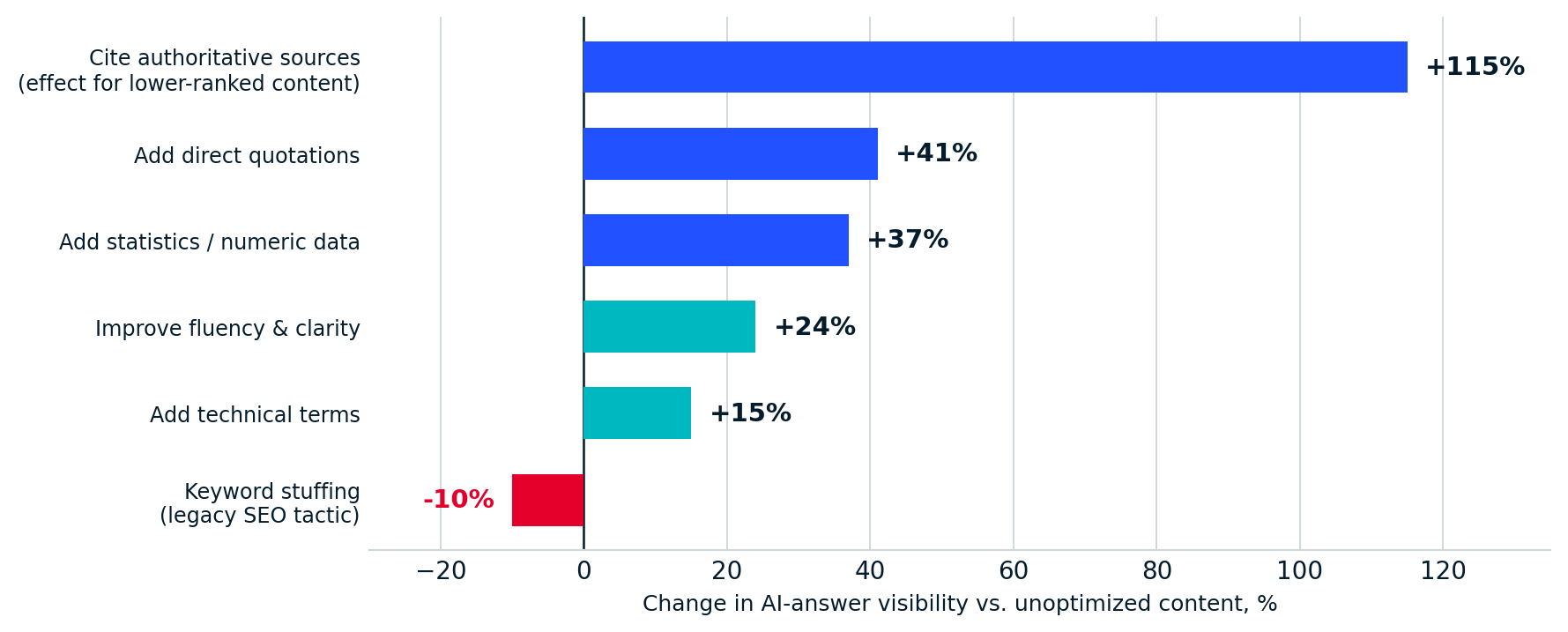
Two further findings deserve board-level attention. First, visibility gains concentrate in lower-ranked content: the Princeton team found pages around position five gained most (up to 115 percent), while position-one pages barely moved — meaning GEO disproportionately rewards challengers and disproportionately punishes incumbents who assume their search dominance carries over.10 Second, AI citation and search ranking are only loosely coupled outside Google's own surfaces: roughly 28 percent of the pages most cited by one leading assistant have no organic search visibility at all, and only around 43 percent of Google position-one pages earn citations from it.13 A strong SEO position is neither necessary nor sufficient for AI visibility.
GEO does not replace SEO — it sits on top of it
Google AI Overviews still correlate strongly with traditional rankings (roughly three-quarters of cited URLs also rank in the organic top ten), while standalone assistants draw from far wider source pools.13 The practical consequence: technical SEO hygiene remains the admission ticket, and GEO determines whether the content actually gets used once admitted. Organizations should plan for a combined discipline, not a substitution.16,17