Workstream A — Establish the baseline (first 90 days)
- A1. Run a multi-model, dual-persona audit for every priority asset. Standardized prompt sets — dosing, efficacy, safety, interactions, special populations — executed as both HCP and patient personas across at least four general-purpose models plus the dominant clinical AI platform in each market. Log every answer, every citation, every URL. This is the gap register everything else prioritizes against.19
- A2. Define the 'ideal answer' per priority query. For each of the top clinical questions per asset, document what a perfect AI response would say, which sources it would cite, and which caveats it must include. This benchmark converts monitoring from anecdote collection into gap measurement.
- A3. Audit URL integrity across the owned estate. Every clinical content page must resolve to one direct, stable, canonical URL. Redirect chains, session parameters, and dead links zero out citation value regardless of content quality.19
- A4. Map the third-party citation ecosystem per asset. Identify which aggregators, reference platforms, and encyclopedic sources models actually cite for the asset, and verify each against the current label. Prioritize correction of the two or three highest-citation-share third parties — in audits, these carried more answer-shaping weight than the entire owned estate.19
Workstream B — Restructure the content estate
- B1. Convert flagship claims to the PICO standard. Begin with the launch or growth asset's core efficacy and safety claims on the corporate site and HCP-facing pages; expand asset by asset. Include confidence intervals, n values, data-cut dates, and population definitions in every retrievable unit.10
- B2. State the negatives explicitly. For every special population and every studied interaction, publish the explicit outcome — including 'no dose adjustment required' and 'not clinically significant' where true per the label. Audit evidence shows explicit negatives are among the highest-value additions per word, because they pre-empt class-effect inference.19
- B3. Give every machine-hostile asset a machine-readable companion. Every conference poster, slide deck, and data-bearing PDF gets a structured HTML companion page carrying the numbers, populations, and endpoints in text and tables. This single practice unlocked more citation improvement in remediation testing than any other format intervention.19
- B4. Publish ungated executive summaries of gated content. Gated portals are categorically invisible to external models. For each gated clinical page, publish an ungated structured summary — key data in text tables, explicit audience labeling, links to primary sources — that gives machines a compliant, accurate surface to retrieve.19
- B5. Separate topics into dedicated pages with semantic architecture. One page per clinical topic (dosing, safety, efficacy, interactions, special populations), each with semantic header hierarchy, consistent entity naming, and audience labels in metadata and body text. Merged mega-pages fragment retrieval chunks and blend contexts.19,24
- B6. Break the paywall on pivotal evidence. Pursue open access — gold, green, or author-accepted-manuscript posting — for pivotal and high-citation publications, and maintain a structured publications index (title, journal, DOI, key data, data-cut date) in HTML on owned properties. Paywalled evidence cedes the citation to derivative coverage.19
Workstream C — Manage the source ecosystem
- C1. Treat regulatory repositories as primary GEO assets. Ensure repository entries (label databases, trial registries) are complete, current, and text-extractable — not minimum-compliance stubs. Models treat these as government-grade authority; an impoverished entry wastes the industry's most trusted surface.19
- C2. Establish editorial engagement with the top-cited aggregators. At launch and at every label update, proactively verify and correct the highest-citation third-party references. A one-time correction on a platform cited across every model outperforms months of owned-content optimization.19
- C3. Maintain the encyclopedic layer. Community-edited encyclopedic entries are indexed from clinical development onward and feed both training corpora and retrieval. Keep entries factual, referenced to Tier 1 sources, and current — within community rules and with full transparency.
- C4. Make label succession machine-legible. At every supplement: update the canonical label URL, mark superseded versions explicitly, publish a 'what changed' summary, and cascade the update to owned pages and managed third parties within days. Version confusion was the single most persistent clinically meaningful error pattern observed.19
- C5. Plan for the walled gardens. Clinical AI platforms ingest curated evidence pipelines. Ensure pivotal publications, registry entries, and guideline submissions meet those pipelines' structural requirements — structured abstracts, complete metadata, open availability — so the asset is present where 40 percent of US physicians now ask their questions.2,3
Workstream D — Build the organizational capability
- D1. Pre-approve GEO content standards with MLR. Bring medical-legal-regulatory review a PICO template, an explicit-negatives standard, and an audience-labeling standard for one-time approval as production formats — before a launch or label update makes the conversation urgent. AI-assisted pre-screening can absorb the added volume; published industry experience reports 50–65 percent cycle-time reductions where AI supports regulatory content workflows.25
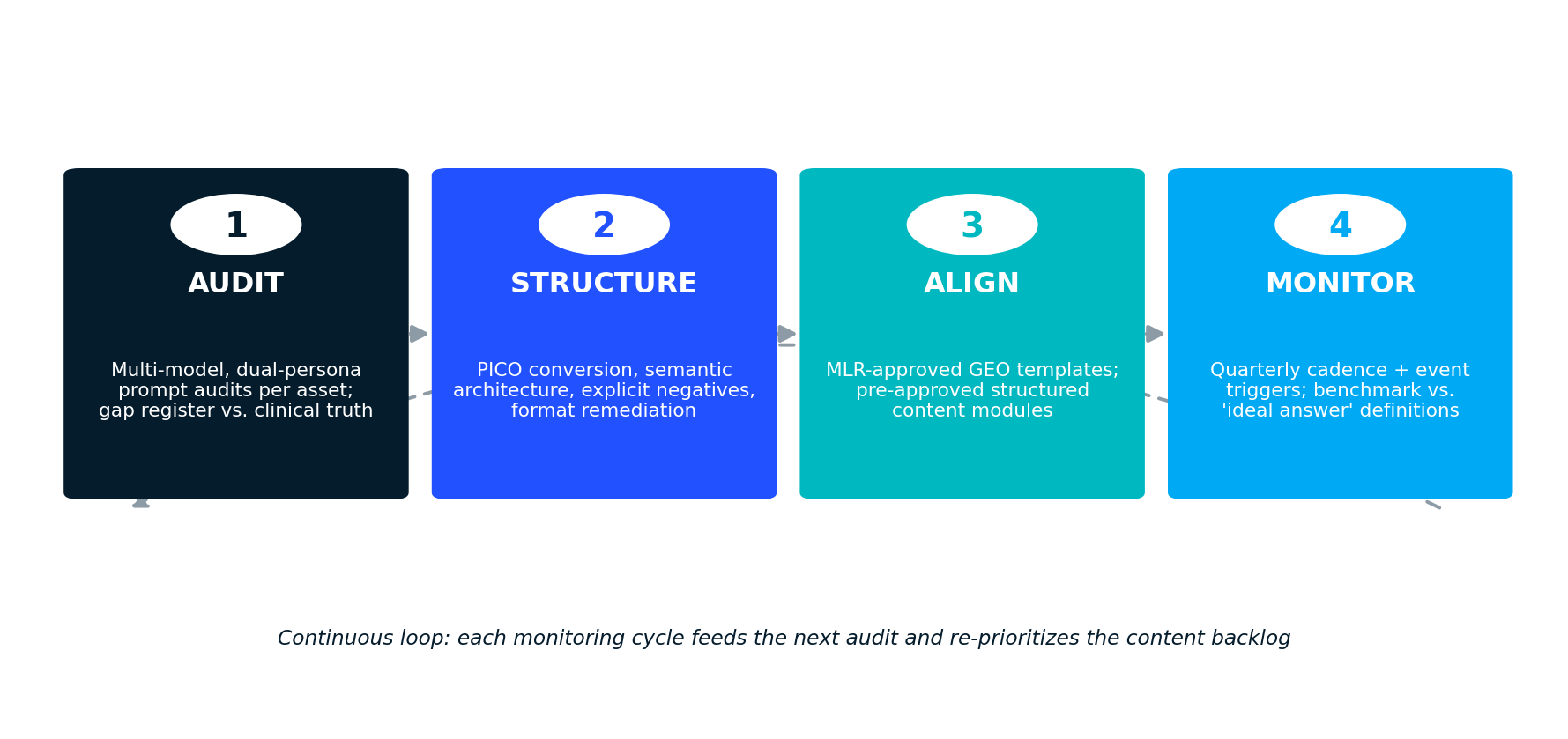
- D2. Assign explicit GEO ownership per asset. Most organizations still lack a named owner for AI visibility.18 Designate one accountable owner per brand for the audit-structure-align-monitor cycle, with dotted lines into medical affairs, digital, and communications.
- D3. Train content creators on machine-readability. Writers, agencies, and medical writers need a short, concrete standard: declarative sentences, numbers with context, co-located safety, explicit negatives, no unexplained superlatives. The peer-reviewed findings translate into a one-page style addendum.10,24
- D4. Extend agency briefs and templates. Every content brief — press release, website, congress asset — carries GEO requirements by default: structured data blocks, HTML companions, canonical URLs, audience labels. Retrofitting is an order of magnitude costlier than building in.
For the full organizational blueprint — governance, workflow, ownership matrix and compliance rules — see Standing up the capability: building GEO in-house.
Workstream E — Govern and measure
- E1. Institute a monitoring cadence with event triggers. Quarterly standardized re-audits at minimum, tightening to weekly through launch windows; additional triggered audits on label updates, major publications, competitor approvals, and safety communications. Model behaviour shifts with every retraining cycle; a point-in-time audit decays fast.19
- E2. Adopt citation-based KPIs. Track answer accuracy versus the ideal-answer benchmark, citation share by tier, share of answers citing the current label version, and the dual-persona accuracy gap — alongside, not instead of, traffic metrics. The detailed measurement architecture is set out in Measuring what matters.
- E3. Add a GEO impact field to content approval. One question in the MLR workflow — 'how will this content read when retrieved by an AI system?' — institutionalizes the discipline at the point of creation.
- E4. Fund it as a strategic function, not an experiment. Cross-industry data shows 92 percent of organizations already experimenting with GEO, with measurable ROI concentrating among those committing more than 5 percent of marketing budgets — treating it as an operating function rather than a pilot.18
Exhibit 9
The GEO operating model: a continuous four-stage cycle